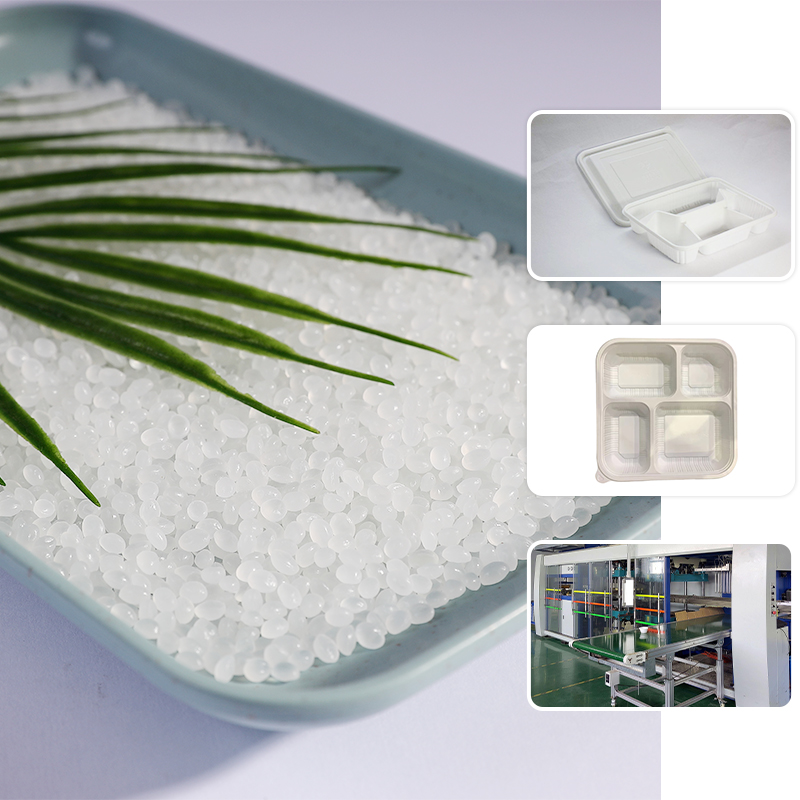
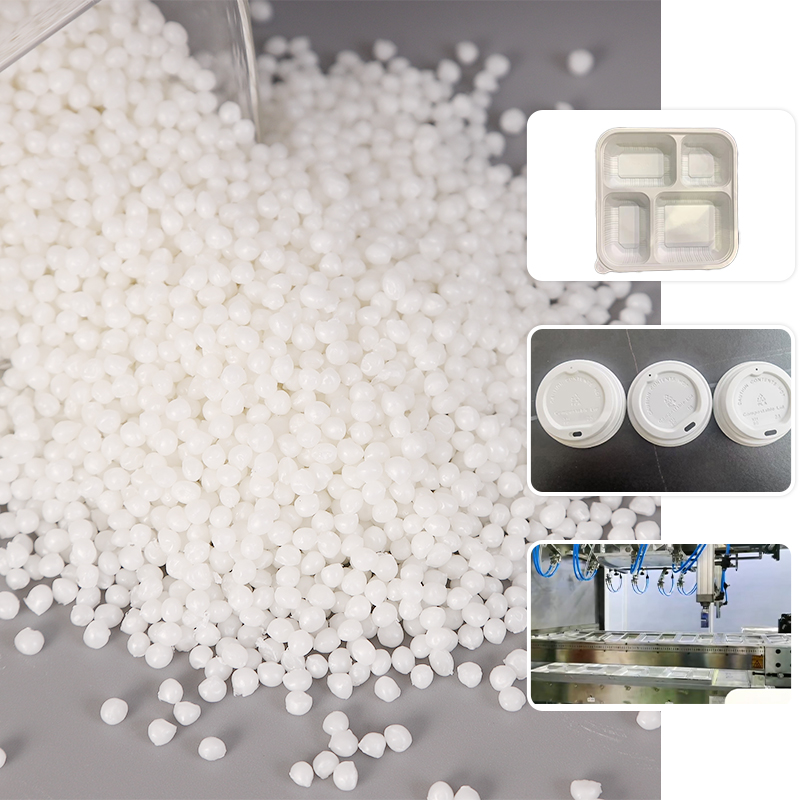
Biomaterials PLA polymer 721 is a thermoplastic resin derived from annually renewable resources and is specifically designed for making heat resistant thermoformed articles.
Resin Properties
|
721 |
Test Method |
| Physical Properties |
| Density( g/cm3) |
1.30±0.05 |
GB/T1033-2010 |
| Melt Index, g/10min (190℃ /2.16kg) |
4-8 |
GB/T3682-2000 |
| Mechanical Properties |
| Tensile Strength (MPa) ≥ |
45 |
GB/T1040-2006 |
| Elongation at Break (%)≥ |
10 |
GB/T1040-2006 |
| Impact Strength (KJ/m2, Izod) |
4-8 |
GB/T1043-2008 |
Applications:
721 is specifically designed for making heat resistant thermoformed articles.
Process Details:
PLA resin 721 can be processed in traditional PET extruder. A sheet thickness between 0.2-1.5 mm is recommended. General equipment requirements are: screw with L/D ratio between 24:1 to 32:1 and smooth stuff barrel. Stuff is stable in melt form given it is properly dried.
PLA resin 721 is different from other resins, and special purging sequences should be followed:
- Clean extruder and bring temperatures to steady state with low-viscosity, general-purpose polystyrene or
- Contamination of hopper system should be avoid, and the humidity of the air should be kept below -40℃ air dew
- PLA resin can be introduced into extruder after step 1 and
- Adjust the temperature of equipment to the operating
- When shutting down, the machine should be cleaned with low-viscosity polystyrene or
Note:
- It is critical that all drying and conveying/receiving systems should be free of all other contaminant and is vacuumed to ensure that there is no remaining other polymer dust before adding PLA. Since the presence of other polymer contaminant that cannot melt at PLA operating temperature will block
- When cleaning extruder with polypropylene, the thermally cross-linked one
should be avoid.
Drying:
721 has been processed by drying crystallization at our factory. The moisture content is less than 200 ppm. The resin is stored in Aluminum foil bag, protected by outer packaging, and can be used directly. It is more favorable if resin user can re-dry the resin with proper drying equipment and lower the moisture content to 100 ppm or less. It will enhance the processability of the resin and the quality of the sheet.
When re-drying the resin, un-dehumidified hot air is forbidden (by using un-dehumidified air, it will speed up water absorption of PLA resin and cause degradation on the resin). Only dehumidified air can guarantee good drying effect of PLA resin in desiccator.
Recommended drying conditions are as follows:
| Drying Parameter |
Typical Settings |
| Residence Time(hours) |
4-6 |
| Air Temperature(℃) |
60 |
| Air Dew Point(℃) |
-40 |
| Air Flow Rate(m3/hr-kg resin) |
>1.85 |
Sheet Extrusion:
A general-purpose single-screw extruder with L/D ratio from 24:1 to 32:1, and a feed-throat cooling system can be used to extrude PLA sheet. It is recommended that static mixers or melt pump should be installed prior to the die to ensure the stability of material conveying. At the same time, screen is also recommended to obtain high quality and large output. Typical PLA sheet extrusion parameters are listed as follows:
Process condition
| Extrusion Area |
Temperature Setting(℃) |
| Feed Throat |
20-40 |
| Zone 1 |
180-210 |
| Zone 2 |
180-210 |
| Zone 3 |
180-210 |
| Filter |
180-210 |
| Melt Pump |
180-210 |
| Die |
180-210 |
Note: 1. Temperature settings can be optimized during the production process.
- Sheet forming should be done on 3-roll stack, inclined or horizontal roll stacks are both acceptable. At the same time, 3-roll stack should be equipped with an accurate temperature control system.
3-roll stack temperature profiles vary depending on the output, melt temperature and roll diameters. The rolls can be divided into three parts according to the distance from the die. Recommended original temperature settings are listed as follows:
| Top roll |
45℃ |
| Middle roll |
35℃ |
| Bottom roll |
25℃ |
Note: 1. Above mentioned temperatures can be adjusted according to the production capacity, melt temperature and roll diameter during the process.
- The stiffness of PLA is similar to PS, but quite different from either PP or PET. Be careful of sharp edges on thin cast sheet. Gloves must be worn to minimize the risk of cuts. PLA also has high elastic modulus, and tension control system must be equipped in the rolling device.
Recovery treatment of renewable materials
PLA scraps can be reused (such renewable materials should not be stored longer than 3 months, and it should not be added to the mix at loadings above 35% ). Owing to the demand that the moisture content of sheet extrusion should be lower than 200 ppm, the renewable materials must be treated with crystallization and high-temperature drying by desiccant device.
Note: Bits and pieces can be reused for several times. During the reuse process, a small amount of assistant agent – ADR can be added to reduce property deterioration of the renewable materials effectively, and the recommended amount is 0.1~0.6%.